Chaos Theory and Its Real-Life Applications: The Complexity of Order
Chaos theory is the study of seemingly random or unpredictable systems that are, in fact, governed by underlying patterns and rules. This fascinating branch of science reveals how complex and dynamic systems behave, showing us that what appears chaotic often contains an intricate order. One of the most well-known concepts within chaos theory is the "butterfly effect," introduced by Edward Lorenz in the 1960s. It demonstrates how small changes in initial conditions—like a butterfly flapping its wings—can lead to massive, unpredictable outcomes.
Chaos theory has revolutionized our understanding of various fields, from weather forecasting to finance, biology, and even social sciences. This article explores the principles of chaos theory and its extraordinary applications in real life.
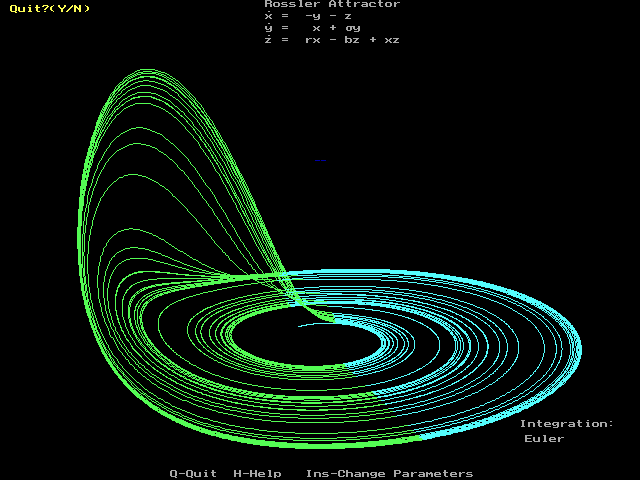
What is Chaos Theory?
Chaos theory focuses on nonlinear dynamic systems that are highly sensitive to initial conditions, a property often referred to as "sensitive dependence." This means that even the smallest change in a system's starting point can lead to vastly different outcomes over time.
Another key element of chaos theory is the presence of fractals—self-repeating patterns that appear at every level of a chaotic system. Fractals demonstrate how chaos can still exhibit order and structure, even in its apparent randomness.
Real-Life Applications of Chaos Theory
1. Weather Forecasting
The atmosphere is one of the most complex and chaotic systems on Earth. Tiny factors like changes in temperature or wind speed interact in ways that make long-term weather prediction extremely difficult. Edward Lorenz's discoveries formed the foundation of modern meteorology, improving weather forecasting models despite their inherent chaos.
2. Economics and Financial Markets
Financial markets often behave chaotically, with small events—such as changes in interest rates or a company’s leadership—triggering significant economic fluctuations. Chaos theory is used to model and understand these unpredictable dynamics, providing tools for risk management and market analysis.
3. Medicine and Healthcare
In medicine, chaos theory is applied to understand complex biological systems such as the human heart or brain. For instance, the irregularity in heart rhythms can be analyzed through chaotic models, revealing whether they signify health or disease. Similarly, neurological disorders like epilepsy are studied using chaos theory to improve diagnosis and treatment strategies.
4. Ecosystem Management
Natural ecosystems, such as predator-prey relationships or population dynamics, are inherently chaotic. Chaos theory helps ecologists understand these interactions and develop strategies for conservation and sustainability. This is particularly crucial in managing climate change and natural resource preservation.
5. Astrophysics and Space Science
The motion of celestial bodies, such as planets and asteroids, exhibits chaotic behavior. Chaos theory allows scientists to predict orbital paths, study gravitational interactions, and explore the long-term stability of planetary systems.
6. Sociology and Psychology
Human behavior and social systems often mirror chaotic systems. For instance, individual decisions, societal trends, or even crowd behavior can be modeled using chaos theory. It helps sociologists and psychologists analyze patterns in human interactions and group dynamics.
Chaos Theory: Order in the Midst of Complexity
Chaos theory provides a new lens through which we can understand the unpredictability of the world around us. It reminds us that even in the most complex and seemingly random systems, there is an underlying order waiting to be uncovered.
From the weather patterns that shape our days to the intricate workings of the human body, chaos theory helps us unravel mysteries and find meaning in the chaos. It inspires us to embrace the complexity of life, knowing that small actions can ripple through systems and create profound impacts—just like the flap of a butterfly’s wings.
Ultimately, chaos theory teaches us that the world is a delicate balance of order and disorder, and understanding this balance opens the door to innovation, exploration, and deeper appreciation of the universe.
References
Gleick, J. (1987). Chaos: Making a new science. Viking.
Lorenz, E. N. (1963). Deterministic nonperiodic flow. Journal of the Atmospheric Sciences, 20(2), 130–141. https://doi.org/10.1175/1520-0469(1963)020<0130:DNF>2.0.CO;2
Mandelbrot, B. B. (1982). The fractal geometry of nature. W. H. Freeman.
Strogatz, S. H. (2000). Nonlinear dynamics and chaos: With applications to physics, biology, chemistry, and engineering. Westview Press.
Thompson, J. M. T., & Stewart, H. B. (2002). Nonlinear dynamics and chaos. John Wiley & Sons.
Turner, M. G., & Gardner, R. H. (2015). Landscape ecology in theory and practice: Pattern and process. Springer.


Comments
Post a Comment