Quantum Entanglement: What is Einstein's 'Spooky Action at a Distance'?
As we dive deeper into the mysteries of the universe, we come across phenomena that are sometimes stranger than science fiction. One of these is quantum entanglement! Even Albert Einstein couldn't hide his amazement and famously referred to it as "spooky action at a distance." This phenomenon has puzzled scientists for decades and remains a mystery to this day. So, what exactly is entanglement, and why did it bother Einstein so much? Let’s unravel this strange aspect of reality together!
What is Quantum Entanglement?
In simple terms, quantum entanglement is when two or more particles become linked in such a way that their states are interdependent, no matter how far apart they are. If you change or measure the state of one particle, the other particle's state instantly changes as well. And here’s the kicker—it happens faster than the speed of light!
Imagine two entangled electrons: one on Earth and the other on Mars. The moment you measure the electron on Earth, the one on Mars automatically "knows" its state. No matter how vast the distance, the effect is instantaneous. This very phenomenon made Einstein uneasy because, in classical physics, nothing should surpass the speed of light.
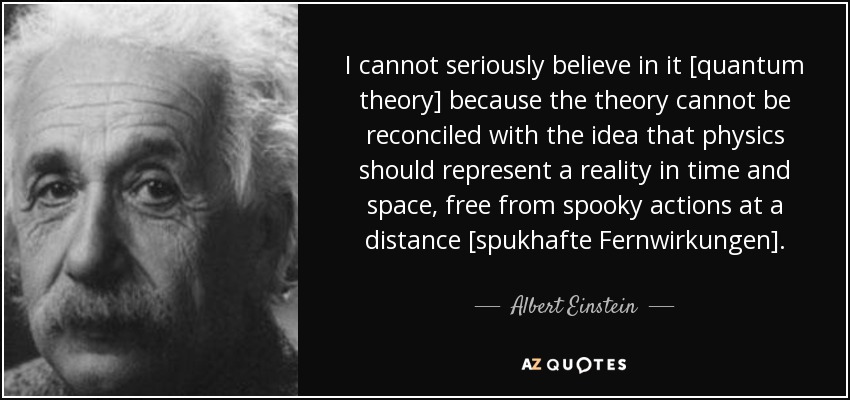
Einstein's Take: 'Spooky Action at a Distance'
Einstein wasn’t entirely comfortable with quantum mechanics. To him, nature operated on strict rules with clear cause-and-effect relationships. Quantum entanglement defied these ideas, and Einstein famously described it as "spooky action at a distance." He believed quantum mechanics was "incomplete."
To explain this oddity, Einstein and other scientists proposed a theory of "hidden variables" that might explain how particles “communicate” instantly. However, in 1964, physicist John Bell developed the Bell Inequality, which debunked hidden variable theories. Modern experiments have since repeatedly confirmed the reality of quantum entanglement.
How Does It Work? Applications in Science and Technology
Quantum entanglement isn’t just a fascinating theoretical concept; it holds groundbreaking applications in modern science and technology:
Quantum Cryptography: Entangled particles are used to create ultra-secure communication systems. If anyone tries to interfere with the system, it is immediately detected.
Quantum Computers: Quantum entanglement is one of the key principles that enable quantum computers to perform calculations at incredible speeds.
Space Communication: Scientists are exploring entanglement for long-distance communication in space, where traditional methods may fail.
Philosophical Implications: What Does This Say About Reality?
Quantum entanglement doesn’t just challenge scientists; it also raises deep philosophical questions. If two particles are so interconnected across vast distances, what does this say about the nature of reality? Is space and time as "absolute" as we believe?
Some theories suggest that entanglement may point to a deeper connection across the universe, perhaps even supporting ideas of the multiverse. Could the entire universe, then, be one giant entangled system?
Conclusion: The Mystery Lives On
Quantum entanglement continues to push the boundaries of physics. Einstein may have found it "spooky," but today we know it’s real and holds tremendous potential for future technologies. Yet, it remains a profound mystery that challenges our understanding of the universe.
So, is quantum entanglement just a scientific curiosity, or does it hold the key to unlocking the deeper secrets of our reality?
References
Einstein, A. (1935). Can quantum-mechanical description of physical reality be considered complete? Physical Review, 47(10), 777-780.
Bohm, D., & Hiley, B. J. (1993). The undivided universe: An ontological interpretation of quantum theory. Routledge.
Aspect, A., Dalibard, J., & Roger, G. (1982). Experimental test of Bell's inequalities using time-varying analyzers. Physical Review Letters, 49(25), 1804–1807.
Schrödinger, E. (1935). Discussion of probability relations between separated systems. Proceedings of the Cambridge Philosophical Society, 31(4), 555-563.
Nielsen, M. A., & Chuang, I. L. (2010). Quantum computation and quantum information (10th ed.). Cambridge University Press.


Comments
Post a Comment